The Secret To Effective Advertising
And how you can use this to improve results

One of the best, yet worst, things about my 9 years of experience in marketing — is that I’ve tried EVERYTHING under the sun.
Don’t know why I have a knack for this, but I just love testing things out.
I’ll see a guy doing “upside down funnels” on Facebook, so I want to leverage this in my business, until I can make it work.
It’s almost like a weird “game” to me, one that isn’t necessarily the smartest from a “profit” standpoint, but it does help me understand everything in totality.
At the point where I can analyze any marketing campaign, seeing how they’re making money within 30 seconds, and even though I’ve found a lot of “tactics” that work — there’s always been one that stands out.
It’s so simple that I HATE talking about it, as I feel like it shouldn’t be this way, but it just works.
Creates leads that say:

And here’s the reason they work so well:
Editorial Advertising Will Always Pull 50% More Readership
This is a (paraphrased) quote taken from the great David Ogilvy, and I could get into a lot of detail on this, but it doesn’t require a rocket scientist to figure it out.
In the simplest terms, people HATE advertising anymore, so if something looks like an ad — they run away.
Don’t want anything to do with it, unless you’re making a “martyr offer”.
Any idiot can “sell”:
“I’ll do all your marketing for free, for the first 90 days.
That means I cover all ad spend and work for free, then I’ll also come to your house and give you a back massage every day.
After these 90 days, if you’re not happy, I’ll keep working for free”…
As it’s a “no-brainer” offer, but the problem with “no-brainer” offers, is how these guys never last 3 months in business.
They’re simply trying to get clients for free, that way they can gain experience, which typically creates a bad breakup later on.
The service-provider gets burnout, as we can only do so much for “free”, and the client gets mad — as they wasted a lot of time and effort for zero results.
Kind of how life works, you get what you pay for, so I’m not going to entertain that type of “marketing”.
It’s not “sustainable”, always short-lived, and I’m writing this for “real” business owners.
Ones that actually like cash flow, as they want to stay around for many years, and need an advertisement that accomplishes this.
Not the typical “brand awareness” ads that take 12 months before they (maybe) see results:

And certainly not the “martyr” marketing that always kills their business in the long-run:

Seeing this, I’ll be showing you how to do that, and here’s the main logic that makes everything work:
Everybody is a narcissist
I know nobody likes to admit it, but at the end of the day, we all are.
For the most part, I think the main reason this doesn’t “land” with a lot of people, is because they have a different “interpretation” of this word.
Whenever they hear “narcissist”, they think of a self-manipulator that hurts others in order to reach their goals, that’s one way to look at it.
There’s certainly people out there that do this, but for me personally, I think most humans are inherently good.
I don’t let a few bad apples ruin my perception of humanity, but at the same time, I know we all work out of “self-interest”.
Heck, even those who donate millions to charity do this, as it makes them “feel good”.
They wouldn’t make this donation if they didn’t feel like they were helping others, providing some form of dopamine on their end — which is a good use of “narcissism”.
It’s just how we all work, and here’s the best way to capitalize on that:
Benefit-driven Advertorials
What I’m about to show you certainly isn’t anything “new”, in fact, it’s how a lot of the giants built their empires years ago.
David Ogilvy was the king of this, where he’d write these types of “advertisements”, then publish them as full-page ads in national newspapers:
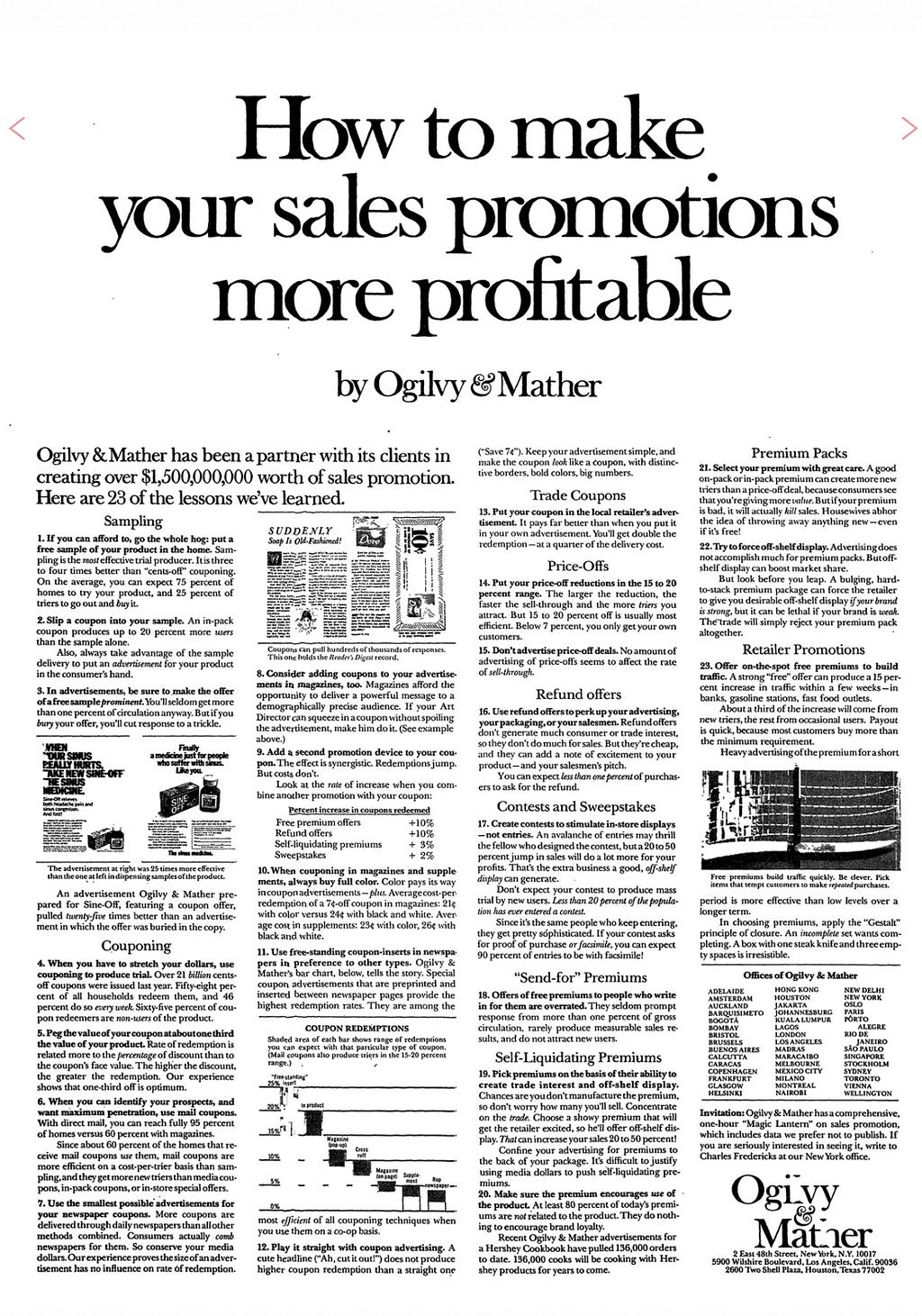
And in turn, generate a lot of business because of it.
His marketing agency now produces roughly $6 BILLION every year, so I’d say it worked, and it’s still something a lot of smart marketers use today.
One of my colleagues has grown a great agency with the same approach, using this “ad” to obtain clients:

And then went onto do the same thing for his clients:

Creating a win-win for everyone involved.
Truly one of the “timeless classics”, something that’ll never go away, as human psychology won’t change — but we simply need to “innovate” and find new ways to leverage this.
When done correctly, that’s what gets people to say this:

But, here’s the caveat:
It’s a little more complex than what everybody thinks
Whenever you look at the type of marketing I’m about to explain, most tend to think it’s simple “content marketing”.
“Oh, all I have to do is write a blog, then people will reach out”…
Something that’s “true”, yet not quite that easy either.
Few reasons for this, but at the end of the day, I’d say most just think too “linear”.
They don’t have a lot of experience with this field, so they write something along the lines of:
“How to save money on tax”…
And don’t get any leads because of it.
Not because the “benefit” isn’t there, but because the alignment is out of whack.
“Tax” applies to everybody, so who are you targeting specifically?
Are you going after affluent individuals, those that make a lot of money via W-2 wages?
If so, then they’re going to be a lot different than business owners making $1M/year.
Obviously a simple example, but one you have to consider, and on top of all that — there’s always “false beliefs” to account for as well.
One of my favorite scenarios with this, was when I worked with a retired Estate Planning Attorney years ago.
If you’ve read a lot of my content in the past, I’m sorry, as I’m sure you’ve heard this before — but it never hurts to have a refresher nonetheless.
In this case, the guy wanted to create a “DIY Will Kit”, primarily because he noticed how a lot of people don’t have a Will.
He thought this had to do with “price”, as some Attorneys charge up to $5K for this work, meaning it’s cost-prohibitive for the Average Joe.
They’re not going to spend that type of money for a Will, meaning he was going to fix this issue, with a $87 “Will Kit”.
One that’d allow people to do it all on their own, but after he created everything and tried to sell it, there were crickets.
Nobody would buy, and he was very confused, so he eventually reached out for my help.
Wanted to see if I could help him with this barrier, and knowing the industry “somewhat”, I decided to give it a shot.
As with everything, the first item I had to do, was figure out his market.
Need to know this as it helps me “position” the product correctly, so after realizing it was Americans who were “somewhat” rich, yet not wealthy — I got to work and did some research.
Had to uncover the “real” reason why they didn’t have a Will, after looking into everything, the answer was obvious:
“They were under the impression of how they didn’t need one”
As one guy said best:
“I appreciate you reaching out, but I don’t need a Will. My spouse is 14 years younger, and everything will go to her anyway”…
Which gave me a good starting point.
I had no idea how I was going to get past this objection, just needed to figure out what it was first, and then started reading a lot of material on the industry.
Wanted to find my “golden nugget”, days later, I had everything I needed.
Did this by uncovering a few case studies that showed how some families (unknowingly) paid thousands of dollars worth of unnecessary “probate” costs, simply because there wasn’t a Will in place.
When that happens, attorneys take longer sorting everything out, and thus increasing the costs because of it.
Knowing that, I started working on my angle, eventually came up with something along the lines of:
“$87 Today, Will Save Your Family Thousands Later On”…
Which ended up working very well.
Had so many people love my Advertorial, that they were “bookmarking” it, and it wasn’t just because of the headline itself.
Instead, after seeing this headline and becoming intrigued, people would click as they obviously want to learn more.
Everybody will gladly spend $87 if it means their family can save thousands later on, they simply have to understand “how” this is done, so I carefully explained my argument after that.
- Why “will-less” estates pay more
- Case studies backing this up
- How a Will can mitigate that
- Secondary arguments to make my primary argument even better (i.e. family feuds)
- Etc…
That way by the time people were done reading this, they actually WANTED a Will.
10 minutes earlier, it was the last thing on their mind, now — they were taking action with their credit cards:
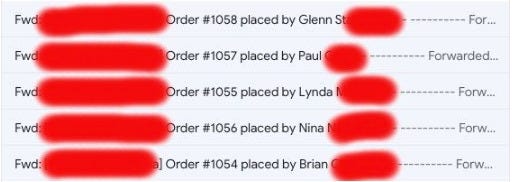
And it all happened because I was able to “frame” the benefit correctly, then explain how they can achieve that benefit.
Again, something easier said than done, but it’s honestly all you NEED in order to create a great advertisement.
I’ve done this with a lot of different industries over the years, but the absolute hardest has been “Commercial Loan Brokers”.
I’ll never work with them again, as 99% of the market doesn’t know what they’re doing, but if it can work there — I’m convinced it can work for anybody.
People absolutely HATE the product these brokers provide, primarily because they’re expensive.
You ask any business owner about them, and they’ll say something along the lines of:
“Loan sharks”…
Then to make matters worse, it’s easily the most saturated market I’ve ever seen.
Everybody and their dog is a Commercial Loan Broker, which is supported by other’s experiences as well:
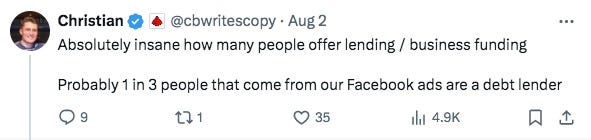
But even with all that going against us, I’ve still been able to create Advertorials that generated well over $11M worth of loan leads — in less than 3 weeks.
How did I do this?
Similar to what I mentioned earlier, where I dug deep, then found a way to “frame” their service correctly.
It’s doable in every situation, just harder in some cases, and with them — I also had to shift their market’s perspective on “price”.
When you go into a bank, it’s not crazy to get a loan for 6%, with these brokers — it can be upwards of 40%.
Truly a “hard sale”, but with the right framing, it’s still possible.
To accomplish that, my main thing was explaining how it’s “cheaper” to work with them, then to avoid their services.
Kind of a crazy thing to do, especially when you’re offering 40% loan rates, but with the right market — it’s actually true as well.
The reason for this, is because a lot of business owners are “unbankable”, meaning banks won’t give them loans.
Few reasons for that, including:
- Too new
- Revenue isn’t large enough
- Business Owner has bad credit
- Etc…
But seeing how this prevents them from getting a bank loan, they’re kind of stuck.
They need money to grow their business, yet can’t get it anywhere else, and these “alternative lenders” are their only hope.
To put this in the best light, I created a “unique mechanism”, that way I could get my foot in the door — then lay out an “argument” that just made sense.
I’m not going to give the exact headline now, as I don’t want a Commercial Loan Broker to take this and use it the wrong way, but it was something along the lines of:
“Need a loan to grow your business? If so, try ROI Financing”…
Which caught their attention.
They’ve never heard of “ROI Financing”, so they wanted to learn more, and then I had to back up my “unique” approach.
If I didn’t, then prospects would be mad, as they’re familiar with “Alternative Lending” — so I took a slightly different approach.
One that not only supported my unique mechanism, but also kept them (the prospect) out of trouble.
Wanted to do this as I know too many Commercial Loan Brokers use this the wrong way, so I said something along the lines of:
“We’ll be honest upfront, our interest rates are A LOT higher than banks, so if you can get a bank loan — go do that.
You’ll save a lot of money doing this, so it’s always going to be your best approach, but we also know some businesses can’t get bank loans either.
Whether it’s because you’re:
- Too new
- Too small
- A business owner with bad credit…
There’s many reasons for this, and that’s the type of people we like to help.
We realize you’re in a bad spot, unable to grow because you can’t get funding, but seeing how this market is riskier — then our interest rates have to account for that.
This is why we’re much higher than banks, and lastly, we only work with a certain type of business owner as well.
In the simplest terms, if you need money for “emergencies”, then we’re not going to help.
A common situation with this would be “payroll”, where you get a loan to cover your upcoming payroll, only makes matters worse.
Our high interest rates will quickly put you in a deeper hole, and seeing how you’re not using these funds to grow, then bankruptcy is inevitable.
Not what we want to do, but at the same time, we’ve noticed how that changes when you’re getting a loan for the “right” reasons.
Many ways to do that, but we’ll keep it simple and say you need $100K for a marketing campaign.
With this campaign, you expect to get $400K in return, meaning you’ll grow the funds by 4x — or $300K “profit”.
Fair enough, and in that case, we’re very interested.
EVEN IF we charged $100K interest on this loan, you’re still profitable, as that’s $200K you wouldn’t have realized otherwise.
Seeing how nobody else will give you funding, we’re the only way you can reach that stage, meaning it’d be more expensive to NOT work with us”…
Etc, you get the hint.
The main goal of this Advertorial was helping them “view” the product correctly, while still helping them make the right decision.
It was one of those rare cases where I had to protect this market, from my clients, as I knew how “dumb” they can be — but the main logic doesn’t change.
When you start off with a “benefit-driven” headline, more people will click, and then when you lay out a good argument after that — more people will buy.
It’s the best way to use “content marketing”, even though it’s technically an “ad”:
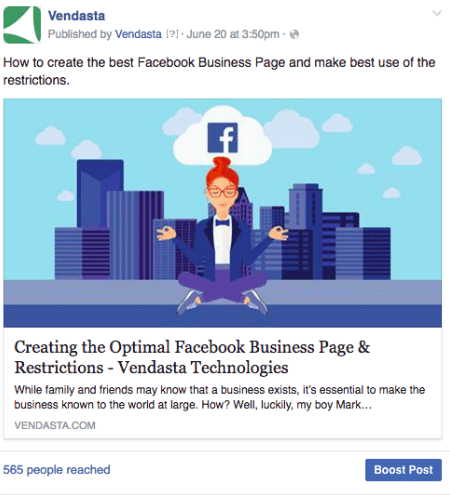
And for the rest of this article, I want to give you a brief overview of how that’d apply to your business.
Not going to get into A LOT of detail here, as I’ve already shared the main gist of everything, but I know there’s a few last items that’ll help you understand everything even better.
Seeing this, let’s explain the process in a series of 4 simple steps, starting with:
Step #1 — Your Foundation
This is easily the most important part of this process overall, yet one everybody overlooks.
I’ve never understood why this is, but it seems like most business owners want to skip to the “tactics”.
They’re like:
“Should I use Facebook Ads or LinkedIn Ads?”…
Without getting the foundation in place, creating an impossible situation because of it.
Can’t answer that question until we get all the other building blocks ready, and even though there’s a few ways I could explain this, the main 4 things we want to figure out are:
- What product or service are we selling?
- Who is this for?
- What’s the main benefit they’ll get from this?
- What are their current thoughts regarding your offer?…
Because once you get that down, then everything else naturally flows into place.
The first one is easy, as you obviously know what you’re selling, but then everybody struggles after that.
They’ll always tell me:
“We don’t have a benefit, we’re just web designers”…
When that’s never the case.
If you didn’t have an actual benefit, nobody would buy your service, there’s always a way to frame this correctly.
Just need experience to do this, and a lot of times, you may have to answer these questions “out of order” as well.
The “traditional” approach is answering these questions in the order of:
- What product or service are we selling?
- Who is this for?
- What’s the main benefit they’ll get from this?
- What are their current thoughts regarding your offer?…
But sometimes, you have to skip around a bit.
To give you a quick example of what I’m saying, I actually helped a web designer years ago, and he was really struggling.
Couldn’t find clients for his business, he’d get a few here and there, but nothing crazy.
Seeing this, I started out by trying to figure out “who” he was targeting, had no idea.
Pretty much anybody who needed a website, so I moved onto the next question first, asking what kind of benefit he could provide?
I mean, in the SIMPLEST terms, that should be:
“Save new business owners time on creating their website”…
But I really don’t like that approach either.
It’d “work”, but you’re also dealing with idiots, so I wanted to find a better angle.
One that’d not only make his work profitable, but also allow him to deal with smart clients, and it didn’t take long for us to do just that.
In his case, he built “customized websites”, ones that brought a lot more capability.
Didn’t use “Wordpress” or anything like that, and there were a few benefits with this, but “site speed” was a big one.
Noticed how his sites were much quicker, and that can be parlayed into a lot of benefits.
- Better SEO
- Increased Ad Conversions
- Etc…
So after writing down all these benefits, I could see we got the creative juices flowing, and he was actually very knowledgeable in “SEO” as a whole.
Knew everything about “meta-tags” and all that, being able to create a website that’d be optimized for SEO, but I didn’t want to stop there either.
Don’t get me wrong, it’d “work”, but I knew we could do a little better.
Seeing this, I then started thinking about “who” his ideal prospects might be.
Would it be bloggers, those that want more organic traffic so they can grow their email list?
Or, would it be ecommerce brands, those that want more organic traffic so they can grow sales on autopilot?
That’s obviously just two main examples, I could split this up into many ways, but for example purposes — let’s just say we went with the latter option.
Decided we were going to target existing e-commerce brands, helping them improve their SEO, and generating more “organic” sales after that.
This is the “angle” we’ll take, but I generally don’t like to stop there either.
It’s great to have a “main benefit”, but then it’s also great to have “secondary” benefits on top of that.
When you can say:
“We’ll help you improve your SEO, generating more sales via organic traffic, but it’ll also help your overall ad conversions as well.
Seeing how slow website speed kills some conversions, this will eliminate that”…
Etc, then it only makes the argument stronger.
That’s the “ideal scenario” here, so we got that in place, then answered the last question of:
“What are their current thoughts regarding your offer?”
To make sure we’re on the same page, the first 3 answers were:
What product or service are you selling?
Customized websites
Who is this for?
Existing ecommerce brands
What’s the main benefit they get?
More sales with their organic traffic…
Which, as you can see, makes this last question A LOT easier.
If you try to answer this without addressing the first 3, it’s very hard, but now it’s fairly simple.
We know exactly who we’re speaking with, so when you think about:
“What are their current thoughts regarding your offer?”
Then you’ll naturally have some answers pop in your head.
A few of those might be:
- Doesn’t know what a customized website is
- Doesn’t think it can help their business that much
- Doesn’t realize how slow site speed is killing their SEO
- Etc…
Which in turn, gives us an “unaware” market.
When they don’t realize there’s a problem in place, we have to “approach” them differently, as they’ll never respond to a “direct” ad.
If we said:
“Ready to increase your site speed?”..
They’d look at us like we’re crazy, as it’s irrelevant and they have no idea what it’ll do for them.
On the other hand, if we say:
“Most ecommerce brands lose thousands of dollars every year, because of this “SEO Leak”…
Then they’re interested.
I’d probably write a slightly better headline, but that’s enough for you to get the hint, and takes us to:
Step #2 — Creating Your Advertorial
Even though I’ve spent a lot of time talking about the “sales” aspect of this asset, at the end of the day, it needs to be “educational” in nature.
That’s how I’ve always loved “selling” people, because when they have the right information, they make the right decisions.
Sure, it’s important to understand the sales logic as well, that way you can:
- Frame the benefits correctly
- Overcome objections
- Etc…
But you never want to go into this with too much of a “sales mentality”, or else you’ll start saying stupid things that kill conversions.
Always fun to read articles that say:
“YOU NEED TO HIRE AN ACCOUNTANT”…
As you can see what they’re doing, so just keep this in mind.
That’s not what we’re trying to do, merely “educating” them into a good decision, and it’s something that’s very hard to teach.
I’ve had to learn A LOT of skills before reaching this point, including:
- High-ticket sales (closing deals of $10K+)
- Copywriting
- Media buying
- Etc…
So it’s not really one “skill” in itself, but if I had to make this simple, I’d say you’re best off just acting like you’re “speaking” with a prospect when creating this.
That’s assuming you find the right angle and everything, as that’s the hard part, but once that’s in place — you have a good “north star” to work back from.
Now that we understand:
What product or service are you selling?
Customized websites
Who is this for?
Existing ecommerce brands
What’s the main benefit they get?
More sales with their organic traffic
What are their current thoughts regarding your offer?
- Doesn’t know what a customized website is
- Doesn’t think it can help their business that much
- Doesn’t realize how slow site speed is killing their SEO
- Etc…
Then your brain naturally starts to understand how you should explain everything.
Seeing how they’re “unaware” of the issue, we’d have to start off by explaining this.
“Shopify is a great product to start with, but the issue is how it’s designed for the masses.
When everybody is using the same software, all “SEO” is similar, and it’s hard to reach the top because of this.
You need to be “better” in order to reach that point, and a big part of this comes down to having better site speed, as Google favors websites that are faster than everybody else.
To accomplish this, you need a customized website”…
And after saying that, I’ll know they’re probably unaware of what a “customized website” is.
Knowing this, I’d move onto the next section of my argument, which is:
“What’s a customized website?”…
Etc, doing all that until I’ve covered everything, and gave them all the information they need.
The actual “length” will differ depending on your situation, but I’ve found 3K — 5K words works best.
That’s enough to provide all the necessary information, without boring them to death, and yes — anybody will read that many words.
I can’t even tell you how many times I’ve had people reach out, saying:
“This is something I might be interested in, but I’d love to see what they look like first.
I’m just scared my market won’t read something that’s this long”…
Then I’m like:
“Jabroni, you just finished one that was 5,400 words long”
That always catches them off guard, as they thought it was like “1,000 words”, which just comes to show how people rarely recognize length when they’re reading something that’s “helpful” to them.
This is the same reason why Netflix is able to captivate your attention for 3 hours, even though you didn’t realize that much time has flown by, so don’t worry about “length” too much.
Simply provide them with all the information necessary, then at the very end, leave a helpful call-to-action.
One that says:
“P.S. That’s all you need to know, but if you’d like our help with this, then you can contact us here”…
As smart clients actually want that.
They know there’s no way you can teach any skill in 5K words, it takes a lot more information (and experience) before reaching that point, but they just want a general overview of how the strategy works.
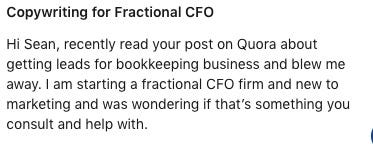
When you can do this (correctly), they’ll want you to do this for them:
And after that’s all done, you’ll then publish this as a blog article on your website.
Remember, it’s educational in nature, so it needs to be a “blog post” — yet one that actually generates revenue for your business.
Not interested in the fluff that wastes time, I’m interested in great content that helps your market, getting them to move forward with a helpful solution:

And after that’s published, we’ll then move onto:
Step #3 — Getting eyeballs on it
Now that we have your Advertorial created, and published as a blog on your website, the next objective is getting people to see this.
Without that, nothing else matters, and one of the more “efficient” strategies will always be doing this by “boosting” it on social media platforms.
Since we’re talking about “advertising” in this article, that shouldn’t come as any surprise, and the actual amount you spend will differ by scenario as well.
For the most part, with me personally, I like to “mentally” spend a certain amount upfront.
One of the bigger downsides with social media advertising anymore, is how you can technically “test” something for $1, I’ve found that does a lot more harm than good.
Don’t care what anybody tells you, you can’t get the right amount of data for that small of a budget, but I’m pragmatic about this as well.
Generally speaking, whenever I do something like this, I “spend” $200 upfront.
That’s what I’m committed to, and almost look at this as a “newspaper” advertisement.
When you “advertise” on there, it’s not like you can shut the ad off after $10, you pay a certain amount and they run it for a week.
The money is already gone, so you let it run its course, but I do still keep an eye on my campaign every day.
For the most part, one thing I always look out for at first, is my “click-through-rate”.
If I spend $20, and see I’ve only gotten one click, then I know my headline either sucks — or my targeting is off.
That’s enough data for me to make this decision, so if that happens, I’ll change things up and then let the process restart again.
At the point in my career where I rarely have trouble with this, but it’s still something I do, and then after that — I like to look at “heatmaps”.
Assuming I’m getting clicks, I then want to analyze my Advertorial, and see where people are “dropping off”.
If I’m getting a 5% CTR, but then everybody leaves midway through the Advertorial, I know some changes need to be made there.
They wouldn’t be “leaving” if not, so I’ll make some tweaks then, and reanalyze after getting more data.
Again, the goal is having to avoid this altogether, that way no changes are made — but it’s important to analyze all that upfront so you can “optimize” before spending too much money.
You’ll never know where the “leaks” are until getting this data, so that’s what the initial ad spend will accomplish, then after doing that and making any necessary tweaks — you should have a “winning” asset that’s generating leads or sales.
From there, you can “scale”, as you know everything works — so it’s hard to give an exact “dollar” amount on this.
If you work with a professional, it’s not hard to reach this point for less than $200, and that’s assuming any tweaks even need to be made.
I’ve had times where it was good “right away”, so it varies, but that’s how you want to view everything.
The first $200 are for “data gathering”, that way you can make tweaks, and then you have a winning asset afterwards.
One that continually pulls in sales for your business, doing so on autopilot, and I don’t want to get into too much detail on “how” to actually boost your Advertorial.
There’s a lot of information out there, but to provide a brief overview, you’ll share your “blog” to your Facebook (or LinkedIn) page — then boost it in front of your ideal audience.
This audience will differ depending on the market you’re targeting, or the angle you took.
If you’re real creative, you can find some unique angles, but this might require a little testing as well.
With the example we just went through, which was “helping ecommerce businesses improve their organic sales”, there’s a lot of different angles you could test.
For starters, you could keep it simple and just do this:
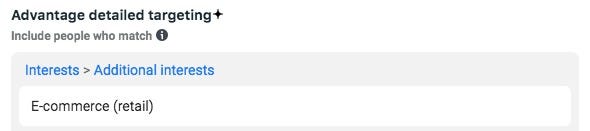
Or you could get crazy and narrow down a bit, saying this:

Seeing how the opener of our Advertorial talked about Shopify, then we know that’d be relevant, and that’s one way you can look at this.
With another ad set, you could try:

As you know that market is inherently interested in SEO, so it might work better.
I’d be a little careful with that, as we know they’re “unaware” of the issue, so adding this targeting option might not be the best approach — but it’s still relevant enough to where it might be worth a shot.
Again, all things to consider, but once you get this optimized — you’ll have an “ad” that works by itself.
Remember, the “ad” is simply a boosted article, looking like this in their timeline:
But it’s still a conversion asset, one that’s designed to have prospects saying this:

Fair enough, that’s profitable already, but then we have one last layer to add on:
Step #4 — Retargeting Ad
Even though our first “ad” will be profitable by itself, we do want to add-on one extra “step” to this process, as it’ll help us recoup a lot of business.
If you’re not familiar with this approach, it’s where we show “traditional” ads to people who’ve read your Advertorial, yet didn’t move forward right away.
There’s a lot of reasons why this could’ve happened, but maybe they just had something come up.
They were interested in your offer, but then the phone rang, and they forgot to move forward because of it.
Seeing that, we can easily create a “retargeting audience” with these clicks, and then show them a traditional retargeting ad later on.
If our initial advertorial was about:
“How to get more organic sales”…
Then our retargeting ad might say:
“Ready for a customized website, increasing your organic sales because of it?”…
And in turn, recouping a lot of these leads because of it.
Very “cheap” to do this as well, depending on your audience size (and platform), you really don’t need to spend over $3/day.
That increases as time goes on, and you have more people in your retargeting audience, but the main goal is simply having some form of “follow-up” in place.
One that recoups leads you’ve already spoken to, creating a system like this:

And even though I know it sounds too good to be true, that’s all you need for “advertising”.
So simple that nobody wants to use this, as they like to make everything “complicated”, but I hope these steps show how that’s not the case.
There’s never a need to “trick” your audience, because whenever they have the right information, they’ll naturally take the next step.
Only consideration with that is how you need to understand “conversational” copywriting, addressing questions or false beliefs as they come up, but that’s the main gist.
Pretty much “selling without selling”, not being a typical douchebag because of it, and that takes us to:
The recap
Long story short, I’ve used a lot of marketing tactics in my day, but nothing beats a good form of “edu-selling”.
In that case, you’re never actually “selling” your market, you’re merely using your experience to help them see everything in the right light.
When we don’t know about an issue, or aren’t looking at it the right way, we’ll never move forward.
On the other hand, when we can learn about a problem that’s holding us back, along with how we can fix it — the next natural step is moving forward with your services.
It’s how everybody operates, we’re not scared to spend money, we just need to see how something can benefit us.
When we don’t have a ton of knowledge and experience in a certain field, we’ll never reach that point on our own, so it’s almost your duty to help us see everything in the right light.
Creates a win-win for everybody involved, and on top of that, there’s a lot of ancillary benefits that come with this.
From faster sales cycles to cheaper clicks, as everybody wants to read something that can benefit them, it mitigates all the problems that come from “traditional” advertising.
Ones that not only make everything a lot more complicated than it needs to be, but also is extremely efficient.
Not unheard of to hear stories about business owners spending thousands of dollars, only to get zero results, this type of advertising fixes all that.
I’m not saying it’ll necessarily print millions overnight, but with a little optimization, you should be able to get your money’s worth — while also having an asset that does all the “heavy lifting” for you on autopilot.
That’s a dream for every business owner and of course, if you’d like me to help you with this, I’ll gladly see if we’d be a good fit.
Done this many times throughout my career, but it’s been a few months, as I’ve been busy with other projects — so I might even cut you a good deal if you reach out today.
Likely a lot cheaper than you’d think, while providing everything you need, so if you’re interested in having me create one of these “advertisements” for your business — then please click on the link below:
And send me a quick message on LinkedIn.
Doesn’t need to be anything wild, something along the lines of:
“Hey Sean,
Want to see if you can create an Advertorial for my business. My website is xyz.com”…
That way I can look at everything quick, and provide a response after that.
Needless to say, that’s it for now, so hope this helps — and hopefully we speak with you soon.
-Sean
The Secret To Effective Advertising was originally published in Bottom Line Grind on Medium, where people are continuing the conversation by highlighting and responding to this story.


